
The Architecture
The Six Modules of a Fair Monetary Order
Each module addresses a documented historical failure. Each has a scientific foundation drawn from complexity theory, ecology, and institutional economics. Each has at least one real-world precedent. They can be implemented independently, in combination, or sequentially.
Download Schematic (PDF)System Schematic
Hover a module card below to highlight its node
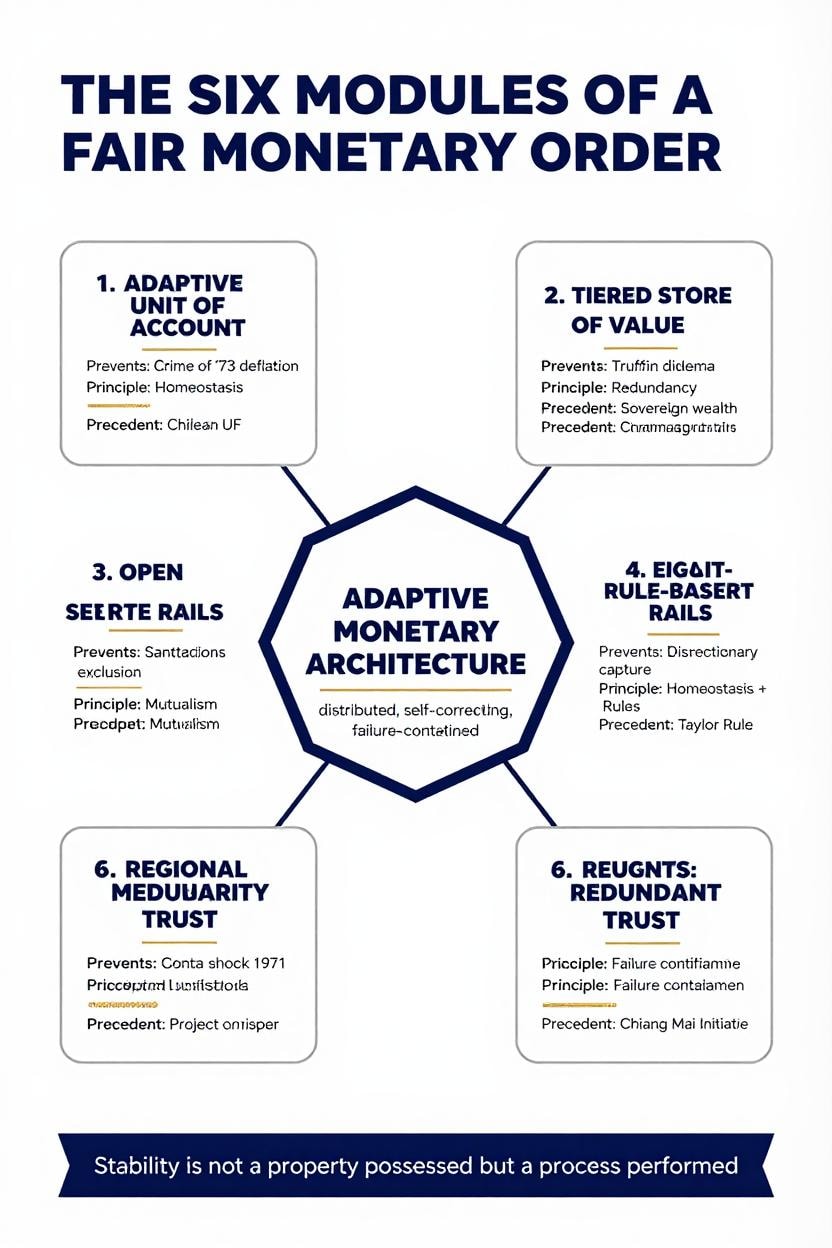
Full system schematic — FairMoney World (2026)
Download PNGFull Reference Table
Module-by-Module Breakdown
| Module | Prevents (Historical Failure) | Principle (Scientific Foundation) | Precedent (Existing Implementation) |
|---|---|---|---|
01 Adaptive Unit of Account A unit of account that adjusts to a transparent basket of indicators rather than holding fixed to a commodity or issuer promise. | 1890s Deflation Fixed nominal anchors force debtors to repay in appreciating currency, transferring wealth upward during contractions. | Adaptive Calibration Systems that adjust to feedback signals rather than holding fixed parameters are more stable under changing conditions (Holling, 1973). | Chilean Unidad de Fomento (UF) Introduced in 1967, the UF adjusts daily to Chile's CPI. Long-term contracts—mortgages, pensions, bonds—are denominated in UF, insulating them from inflation and deflation alike. It has operated continuously for nearly sixty years. |
02 Tiered Store of Value Separate the functions of money: transaction currencies for daily exchange, reserve assets for long-term storage, a global unit for international accounting. | Triffin's Dilemma When one currency serves as both domestic medium of exchange and global reserve asset, the issuer must run deficits to supply liquidity—eventually undermining the peg. | Functional Separation Separating functions that create conflicting incentives reduces systemic fragility. A system where transaction, reserve, and accounting functions are distinct is more robust than one where they are bundled. | Norway Government Pension Fund Global The GPFG separates Norway's oil revenues from its domestic currency, managing them under explicit rules that prevent the fund from distorting domestic monetary conditions. It demonstrates that large reserve assets can be governed without becoming tools of coercion. |
03 Open Settlement Rails Settlement infrastructure that operates across political jurisdictions without a single controlling authority, making exclusion structurally impossible rather than merely prohibited. | Sanctions Exclusion Settlement infrastructure controlled by a single sovereign can be weaponized. Exclusion from SWIFT and dollar-clearing systems demonstrates that the current architecture is not neutral. | Distributed Infrastructure Networks without single points of control are more resilient to both failure and capture. The internet's architecture—designed to route around damage—is the canonical engineering example. | Champagne Fairs (12th–14th c.) & BIS Project Nexus The Champagne fairs operated a multilateral clearing system across political jurisdictions without a central authority for over a century. BIS Project Nexus (2021–present) demonstrates that modern payment systems can achieve interoperability across central banks without a single controlling node. |
04 Rule-Based Elasticity Explicit, publicly auditable rules for money creation that constrain discretion, reduce capture risk, and make monetary policy contestable by non-specialists. | Discretionary Capture Discretionary monetary policy concentrates power in committees susceptible to capture by governments, financial interests, or prevailing ideology. The 1970s inflation and the post-2008 asset price inflation both reflect this vulnerability. | Constrained Optimization Rules that constrain discretion without eliminating judgment reduce the variance of outcomes and make policy more contestable. Transparency is a prerequisite for accountability. | Taylor Rule (1993) John Taylor's 1993 rule—adjusting the federal funds rate in response to inflation and output gaps—demonstrated that rule-based frameworks can guide monetary policy without eliminating central bank judgment. It has shaped practice at the Fed, ECB, and Bank of England for three decades. |
05 Redundant Trust Trust distributed across multiple institutions and mechanisms, so that the failure of any single anchor does not collapse the system. | Nixon Shock (1971) When the entire system's trust rests on a single anchor—gold convertibility, a central bank's credibility—a unilateral decision by one actor can collapse the architecture overnight. | Redundancy Redundancy—multiple components performing similar functions—is a core property of resilient systems. The failure of one trust anchor should not propagate to others (Holling, 1973; Walker & Salt, 2006). | Bank of Canada Project Jasper Project Jasper (2016–2019) demonstrated that distributed ledger technology can provide settlement finality without requiring a single trusted intermediary. Multiple institutions can jointly guarantee settlement without any one of them being a single point of failure. |
06 Regional Modularity Loose coupling between regional monetary systems, so that failure is contained rather than propagated—monetary firewalls that preserve global integration while limiting contagion. | 1930s Contagion Tight coupling between national monetary systems meant that the failure of one propagated globally. The Great Depression demonstrated that a world without monetary firewalls is a world where local crises become global catastrophes. | Modularity Loose coupling between subsystems contains failure. A modular architecture allows one region to experience monetary stress without that stress propagating to all others—the opposite of the 1930s experience. | Chiang Mai Initiative Multilateralisation The CMIM—a network of bilateral and multilateral currency swap arrangements among ASEAN+3 countries—provides a regional monetary safety net that has been tested in crisis. It demonstrates that regional monetary cooperation can buffer against global contagion without requiring a global institution. |
All precedents are operational or have been operationally tested. Citations available in the full working paper bibliography.
In Depth
Each Module, Explained
Adaptive Unit of Account
A unit of account that adjusts to a transparent basket of indicators rather than holding fixed to a commodity or issuer promise.
Prevents
1890s Deflation
Fixed nominal anchors force debtors to repay in appreciating currency, transferring wealth upward during contractions.
Principle
Adaptive Calibration
Systems that adjust to feedback signals rather than holding fixed parameters are more stable under changing conditions (Holling, 1973).
Precedent
Chilean Unidad de Fomento (UF)
Introduced in 1967, the UF adjusts daily to Chile's CPI. Long-term contracts—mortgages, pensions, bonds—are denominated in UF, insulating them from inflation and deflation alike. It has operated continuously for nearly sixty years.
Tiered Store of Value
Separate the functions of money: transaction currencies for daily exchange, reserve assets for long-term storage, a global unit for international accounting.
Prevents
Triffin's Dilemma
When one currency serves as both domestic medium of exchange and global reserve asset, the issuer must run deficits to supply liquidity—eventually undermining the peg.
Principle
Functional Separation
Separating functions that create conflicting incentives reduces systemic fragility. A system where transaction, reserve, and accounting functions are distinct is more robust than one where they are bundled.
Precedent
Norway Government Pension Fund Global
The GPFG separates Norway's oil revenues from its domestic currency, managing them under explicit rules that prevent the fund from distorting domestic monetary conditions. It demonstrates that large reserve assets can be governed without becoming tools of coercion.
Open Settlement Rails
Settlement infrastructure that operates across political jurisdictions without a single controlling authority, making exclusion structurally impossible rather than merely prohibited.
Prevents
Sanctions Exclusion
Settlement infrastructure controlled by a single sovereign can be weaponized. Exclusion from SWIFT and dollar-clearing systems demonstrates that the current architecture is not neutral.
Principle
Distributed Infrastructure
Networks without single points of control are more resilient to both failure and capture. The internet's architecture—designed to route around damage—is the canonical engineering example.
Precedent
Champagne Fairs (12th–14th c.) & BIS Project Nexus
The Champagne fairs operated a multilateral clearing system across political jurisdictions without a central authority for over a century. BIS Project Nexus (2021–present) demonstrates that modern payment systems can achieve interoperability across central banks without a single controlling node.
Rule-Based Elasticity
Explicit, publicly auditable rules for money creation that constrain discretion, reduce capture risk, and make monetary policy contestable by non-specialists.
Prevents
Discretionary Capture
Discretionary monetary policy concentrates power in committees susceptible to capture by governments, financial interests, or prevailing ideology. The 1970s inflation and the post-2008 asset price inflation both reflect this vulnerability.
Principle
Constrained Optimization
Rules that constrain discretion without eliminating judgment reduce the variance of outcomes and make policy more contestable. Transparency is a prerequisite for accountability.
Precedent
Taylor Rule (1993)
John Taylor's 1993 rule—adjusting the federal funds rate in response to inflation and output gaps—demonstrated that rule-based frameworks can guide monetary policy without eliminating central bank judgment. It has shaped practice at the Fed, ECB, and Bank of England for three decades.
Redundant Trust
Trust distributed across multiple institutions and mechanisms, so that the failure of any single anchor does not collapse the system.
Prevents
Nixon Shock (1971)
When the entire system's trust rests on a single anchor—gold convertibility, a central bank's credibility—a unilateral decision by one actor can collapse the architecture overnight.
Principle
Redundancy
Redundancy—multiple components performing similar functions—is a core property of resilient systems. The failure of one trust anchor should not propagate to others (Holling, 1973; Walker & Salt, 2006).
Precedent
Bank of Canada Project Jasper
Project Jasper (2016–2019) demonstrated that distributed ledger technology can provide settlement finality without requiring a single trusted intermediary. Multiple institutions can jointly guarantee settlement without any one of them being a single point of failure.
Regional Modularity
Loose coupling between regional monetary systems, so that failure is contained rather than propagated—monetary firewalls that preserve global integration while limiting contagion.
Prevents
1930s Contagion
Tight coupling between national monetary systems meant that the failure of one propagated globally. The Great Depression demonstrated that a world without monetary firewalls is a world where local crises become global catastrophes.
Principle
Modularity
Loose coupling between subsystems contains failure. A modular architecture allows one region to experience monetary stress without that stress propagating to all others—the opposite of the 1930s experience.
Precedent
Chiang Mai Initiative Multilateralisation
The CMIM—a network of bilateral and multilateral currency swap arrangements among ASEAN+3 countries—provides a regional monetary safety net that has been tested in crisis. It demonstrates that regional monetary cooperation can buffer against global contagion without requiring a global institution.
Download the Full Schematic
The schematic PDF includes the hub diagram, the full reference table, and a one-page summary of each module with citations. Formatted for print and presentation.